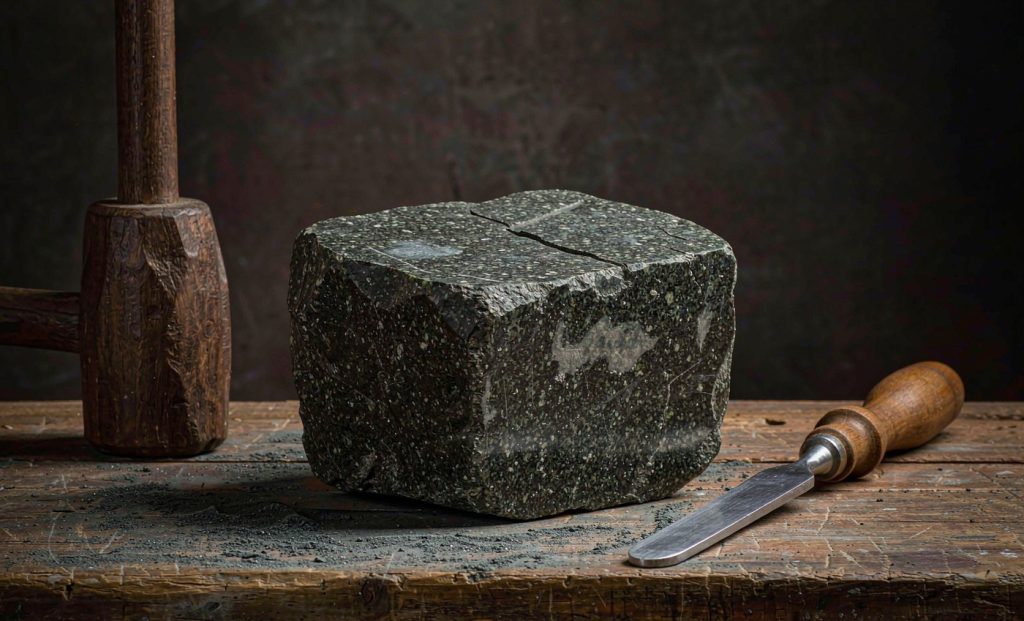
Every piece in our stone-carvings department is cut from one material: the dark green stone that carvers in southern China call green-bean-blue stone. This note is about the stone itself — what the name means, where it comes from, how it behaves under the chisel, and what makes it different from the coarser stones it is often confused with.
This series is about the tradition and the material. It is not a provenance claim for any piece listed for sale.
What the name means
“Green-bean-blue” describes what you see in the body of the stone: small, close-set flecks of mineral held in a dark ground, the way green beans sit in a bowl. The comparison is the region’s own, and it is accurate — the speckling is part of the stone and runs through the block rather than sitting on the surface. The ground colour is a deep green that reads almost blue-grey in low light, and it is the flecking that gives the material its name.
Where it comes from
Green-bean-blue is the finest grade of the dark carving stone the Fujian trade simply calls blue stone. The blue-stone country runs through the hills of Fujian province, and the stone has been cut there for as long as the region has been building in it. Huian, on the coast, has been the centre of the carving trade for centuries, and its workshops have always drawn on the quarries of the province: the finest green-bean-blue has long been associated with the workings at Luoyuan, east of Fuzhou, and with the older seams nearer the carving towns themselves.
Those workings are now closed. No new rough of this quality is being cut, the material cannot be supplied again, and everything in the collection was cut from what was already in the yard.
Why it is mistaken for jade
Held up to the light, a worked face of this stone reads as jade: a deep green ground, flecks suspended in it, a soft sheen where a surface has been handled. The comparison is an old one and it is wrong in an instructive way. This stone is not jade, and no piece in the collection is offered as jade. What the resemblance points at is real, though: the stone is close-grained enough to take a polish and fine enough to carry small detail, which most stones of this darkness cannot do. It is markedly harder than marble and far denser than the soft carving stones, and that is exactly why the same material could serve a temple column and a desk ornament.
Dense, hard, and slow to change
The stone is dense and hard, with high compressive strength — which is why it was used for structural and outdoor work as well as for small objects. It resists weathering and it holds its colour instead of fading: work that has stood outside for generations keeps a depth of tone that softer stones lose. Away from weather, the same density is what preserves a carved surface, so tool marks and the patina of handling stay legible.
Why it suits fine carving
The grain is fine and the stone is tough, and the two together are the point. A finer stone takes a line cleanly and holds a small detail without crumbling at the edges, so it can carry close-set ornament that a coarser stone has to simplify. Granite, by comparison, is coarser in texture and reads bolder and heavier — the material for large architectural work rather than for a lion’s paw or a fine inscription. In the building tradition of the Minnan region the two are used side by side: dark stone for the carved elements, light granite for mass and structure, so that the carving reads against the paler ground.
Working with the stone, not against it
Because the material has its own pattern, the design follows it. Carvers read a block before cutting: the grain and the veining set the course of the work, and a harder or darker area can be turned into part of the carving instead of being cut away as a fault. It is the reason two pieces carved from the same kind of stone never come out the same, and the reason each of ours is a one-off.
How it ages
Green-bean-blue stone does not need sealing or finishing to look right. It darkens very slightly with handling, takes a soft sheen where it is touched, and keeps its flecking visible throughout. Chips, pitting and wear read as history rather than damage — which is why every piece in the collection is sold exactly as it stands, without restoration or retouching.
Where to see it
The pieces for sale are all carved from this stone and photographed as they stand, every face including the base. See them in the Carved Stone Collection, where the material note is set out in full, and read the rest of the series on the Minnan in Stone index. Measurements and an estimated weight are given on each listing, and we will measure the piece you are interested in before you commit.