Ask how a stone carving is made and the answer is usually one word: carved. In the Minnan tradition the answer is five words, and the difference matters. A carver chooses among five distinct ways of cutting, often on the same block, and the choice is what separates a southern-school piece from a northern one at a glance.
This series is about the tradition and the material. It is not a provenance claim for any piece listed for sale.
Five ways to cut one stone
The five are round work, relief, line carving, sunk carving and shadow carving. Round work is carving in the free round: the form stands clear of any backing stone and has to read from every side, which is what a guardian beast is. Relief raises a subject off a ground that stays. Line carving cuts a drawing into the surface with the edge of the chisel and no modelling at all. Sunk carving takes the ground down and leaves the subject standing inside it — the reverse of relief in effect, though not in method. Shadow carving builds an image out of dots tapped into a polished dark slab with a steel needle: a light tap leaves the stone dark, a heavy one turns it pale, and tone is a matter of how densely and how deeply the dots fall.
Of the five, four take stone away and the fifth barely does: shadow carving removes only the polish, dot by dot, and it is the one that has to be learned on a finished surface.
The block is read first
Every method begins the same way, with the carver reading the block rather than the drawing. Grain and veining set the course of the work, and a harder or darker patch is turned into part of the subject instead of being cut out as a fault. That is not a romantic habit. The stone is hard enough that fighting it wastes tools and time, and the flecking runs through the block rather than sitting on its surface, so a design that ignores it will show a seam in the wrong place.
The four stages
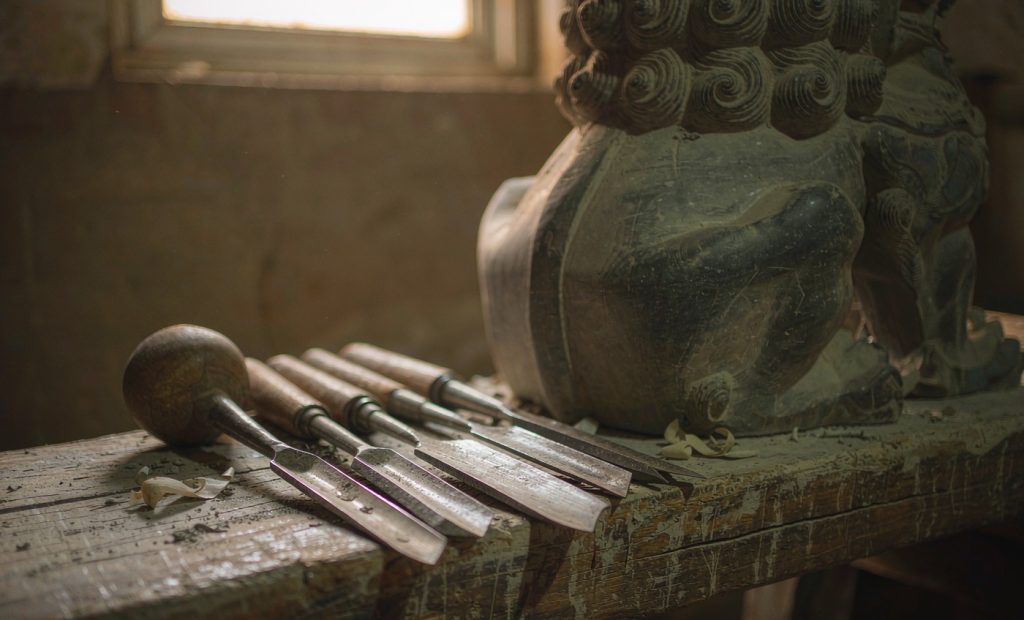
Round work — the lion, the beast, the seal knob — moves in four stages. The form is blocked out of the rough. The waste is taken away. The shape is trimmed close to its final line. The fine cutting comes last, when there is no longer any margin for error, because a chisel that goes too deep cannot be paid back. A carver working this way leaves the tool marks in: they are the evidence that the surface was cut by hand, and the reason two pieces from the same block are never the same.
The lion that broke the rule
The clearest marker of the southern school is the lion. The northern manner is a lion that sits square, faces you and looks dangerous — a symbol of authority first and an animal second. The southern lion, worked out in the Qing by the carver Li Zhou of Chongwu, turned its head, lifted it, took a ball into its mouth and a ribbon at its chest, and became a creature that greets. The subject did not change; the reading of it did, from guarding to welcoming, and the ornament of a whole building softened with it. Almost every lion cut in a Minnan workshop since descends from that turn.
The rest of the southern manner follows the same instinct: more line, more layering, a lighter hand on the surface, and a preference for subjects that move. Set a northern and a southern lion side by side and the difference is not skill — it is what the carver thought the lion was for.
Left by hand, and left visible
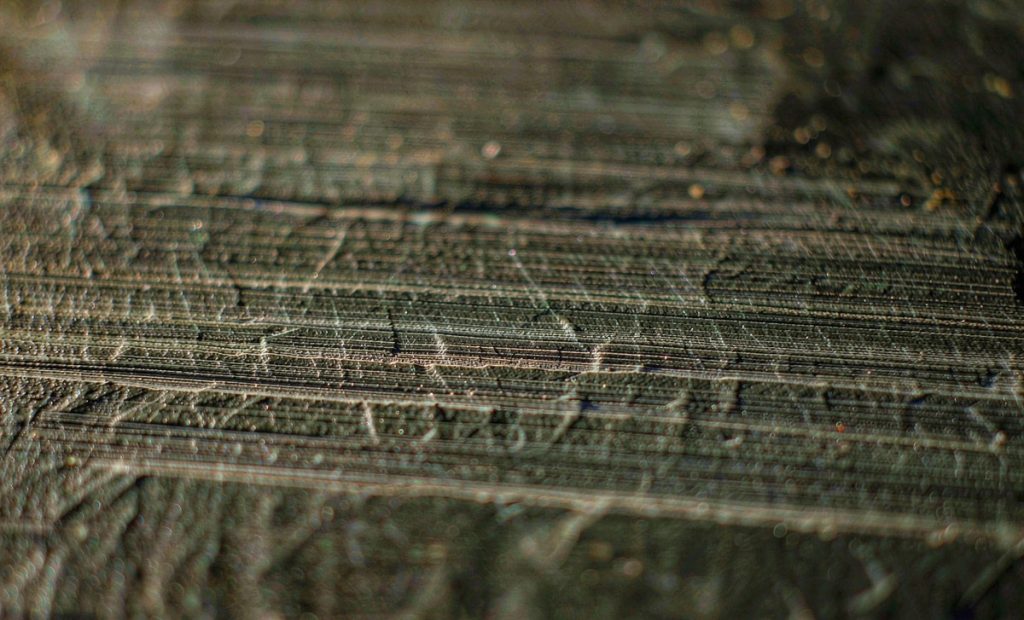
The architectural work has largely gone to machines, and sensibly: a column that has to be true to the millimetre is a machine job. A desk piece is a different case. Hand cutting is slower and it is visible, in the same way a hand plane is visible on timber — in the slight unevenness of a line and the small variation from one stroke to the next. That unevenness is the record of the maker, and it cannot be put back once a surface has been smoothed over.
Why the hand method is thinning out
The trade is straightforward about this. Machine cutting has taken most of the volume, the skill moves in a closed circuit from carver to apprentice rather than through a school, and fewer people are entering. That is what a heritage listing is for: it does not make the work easier, it records that the method exists and names who is left who can do it. The four-stage hand method described above is the part of the tradition most at risk, and it is the part a desk carving is the clearest record of.
Where to see it
The pieces in the Carved Stone Collection are all cut in the round, all worked by hand, and photographed on every face so the tool marks can be read rather than taken on trust. The rest of the series is collected on the Minnan in Stone index.