Stone carving on the south Fujian coast is not a surviving fragment of something older. It is a working tradition that has run for something over sixteen hundred years, and every stage of it is still legible — in the bridges and the temple columns, in the desk pieces of the Qing, and in the way a carver in the region reads a block today. This note follows that line, and it ends where the pieces in our collection sit in it.
This series is about the tradition and the material. It is not a provenance claim for any piece listed for sale.
Where it starts
The earliest carving in the region that can be dated stands at tombs: figures of men and animals set before burials of the Jin dynasty, more than sixteen hundred years ago. The manner is plain and heavy, and the line it comes from is the central plains of China — northern carving carried south by people moving south. What the region did with that inheritance is the story.
Bridges, pagodas and the port
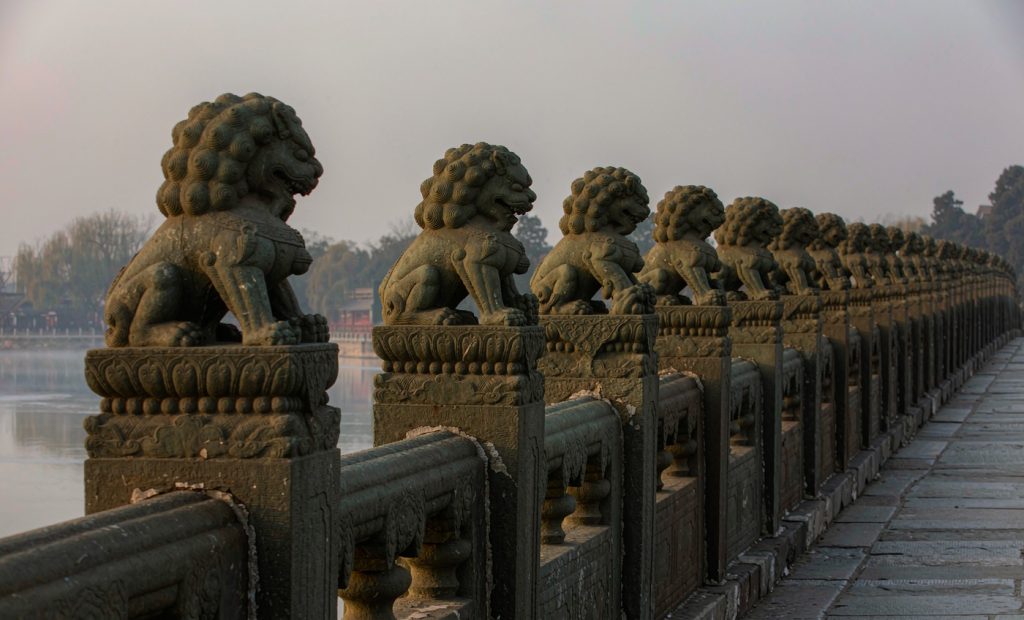
Through the Song and Yuan dynasties the trade of the Quanzhou coast paid for building on a scale the region had not seen: bridges across the tidal inlets, pagodas, temple compounds, and the stone fittings that went with all of them. The carving travelled with the building. Luoyang Bridge, on the river north of Quanzhou and the oldest surviving cross-sea beam bridge in China, was built by masons from the Huian coast, and the stone lions along its balustrade are the earliest lion carving in the region that can be securely dated.
The turn to the desk
By the late Ming, as merchant families along the coast grew wealthy, carving stopped being only architectural. Small work came into fashion: guardian beasts, seals and sceptres for the desk, cut from the same dark stone by the same hands and set in studies and reception rooms where they were handled rather than walked past. Desk pieces of this kind were made from the late Ming through the Qing — roughly 120 to 400 years ago, which is the window each listing in the collection gives.
The carver who turned the lion
Before the Qing, a guardian lion sat square, faced forward and looked dangerous — the northern manner the region had inherited. The carver credited with breaking that is Li Zhou of Chongwu, on the Huian coast. The sources that record him put his working life across the Kangxi and Qianlong years, with the dates given as 1662 to 1795, and he is the first carver of the region whose name is written down rather than remembered.
The story told about him is that his master, cutting a lion, chipped a corner off its tongue and put the tools down in disgust. Li Zhou looked at the block, cut the head raised and turned instead of square and level, and turned a spoiled lion into a good-natured one. Out of that repair came the southern lion: head lifted, a ball in the mouth, a ribbon at the chest, a ball or a cub under the paw — a lion that greets rather than threatens. Eighteen of his lions stood on the posts of the Wanshou Bridge at Fuzhou, and his dragon columns and lion pairs survive in temple courtyards at Fuzhou and at Baijiao, across the water from Xiamen.
He also worked painting into stone, tapping an image out of a polished dark slab with a fine steel needle. That method became shadow carving, which the craft note in this series takes up in full.
What the listing means
In 2006 Huian stone carving was entered on the first national list of intangible cultural heritage: the traditional-arts category, entry VII-36, declared by Huian county in Fujian. The list is a description rather than an award. It records a craft that passes from carver to carver rather than from a book, and it names the reason the hand method is thinning out — machine cutting has taken the architectural volume, and the workshop-to-workshop way the skill moves makes it hard for an outsider to learn properly.
The stone trade sums up the standing of the place in one line: in the south, Huian; in the north, Quyang.
Who carries it now
The lineage is documented. Jiang Qinquan, born in 1958 at Chongwu on the Huian coast, is the sixth head of a stone-carving family whose shop record runs back to the Qing. He entered the trade at thirteen and was apprenticed in the state Huian stone-carving factory in 1973. He is recognised as a national-level representative inheritor of the Minnan traditional house-building technique — the craft of putting stone, timber and tile together, of which carved stone is one part — and in 2025 he was named one of the grand craftsmen of cultural relics. He runs a teaching workshop in his home village, which is how the line continues.
Where that leaves the pieces
None of this makes an individual carving older or better than it is. What it does is explain what a piece of this kind is a record of: a material from a closed seam, a method of cutting that moved hand to hand across centuries, and a subject whose meaning has not changed much since it was cut. The pieces are listed and photographed individually on the Carved Stone Collection page, and the rest of the series is collected on the Minnan in Stone index.