Prayer beads are among the oldest personal objects still in daily use. A mala is not simply jewellery; it is a tool for counting, and the material and construction matter as much as the look.
Count and structure
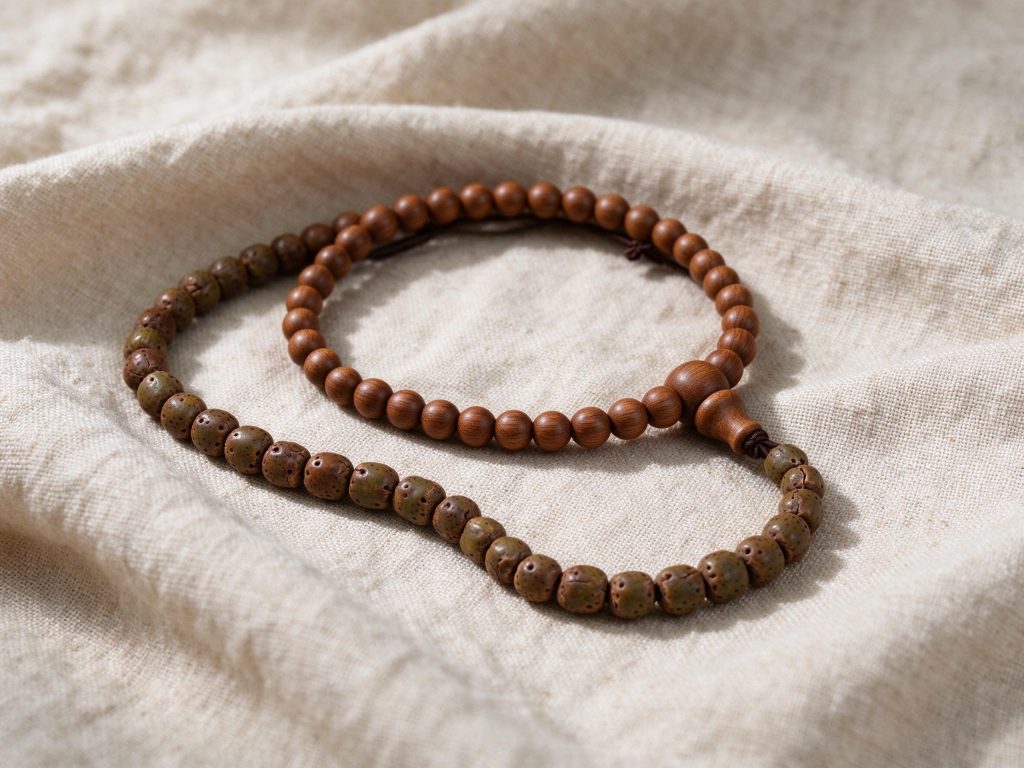
A traditional mala has 108 beads, used to count repetitions of a mantra. Smaller wrist malas often carry 18 or 21 beads for shorter practice. The count should be consistent, and the beads should be uniform in size so the fingers can move without catching.
Materials
Sandalwood is light, fragrant, and warm, and it is the most common material for daily wear. Bodhi seed is traditional and develops a deep patina with handling. Rosewood is dense and dark, and suits those who prefer a heavier bead. Jade and stone beads are cooler and more decorative.
Construction
Check the knot at the guru bead and the tension of the cord. A well-strung mala holds its shape when draped and does not gap between beads. Elastic cord is convenient but wears; knotted cord lasts longer.
Wearing and care
Keep beads away from water and perfume. Sandalwood and bodhi both darken and smooth with handling, which is part of their appeal. Wear them, use them, and let them age.
A mala chosen for material and construction, rather than decoration alone, becomes something you keep for years.